Feng Shui for Beginners: 6 Furniture Arrangement Rules That Actually Work
Feng shui is an old system for arranging a room so it feels calm instead of restless. Strip away the mysticism and most of it comes down to six practical rules about sightlines, support, flow and balance. All six work in a rental, and none needs a purchase.
You've moved the sofa three times. The room is tidy, the lighting is fine, and it still feels slightly off. Not wrong, exactly. Just restless, like you can never fully relax in it.
That feeling is what feng shui was invented to fix. It's a Chinese system for arranging spaces that has been refined over thousands of years, and it has a reputation for being either deeply spiritual or deeply silly, depending on who you ask. This post takes a third route: the rules that hold up in practice, and the reasons they work.
Do you have to believe in chi?
No. In feng shui, chi is the energy that is said to move through a room. You can treat it as a metaphor for something measurable: how easily you can walk through a space, how safe you feel in it, and how much your eyes have to work. The rules below hold up on those terms alone.
Notice how many of the rules are really about human behavior. People relax when they can see who's coming through the door. They feel tense when they have their back to open space. They trip over furniture that blocks the natural path. Feng shui encoded those observations long before anyone called it environmental psychology.
Rule 1: Take the command position
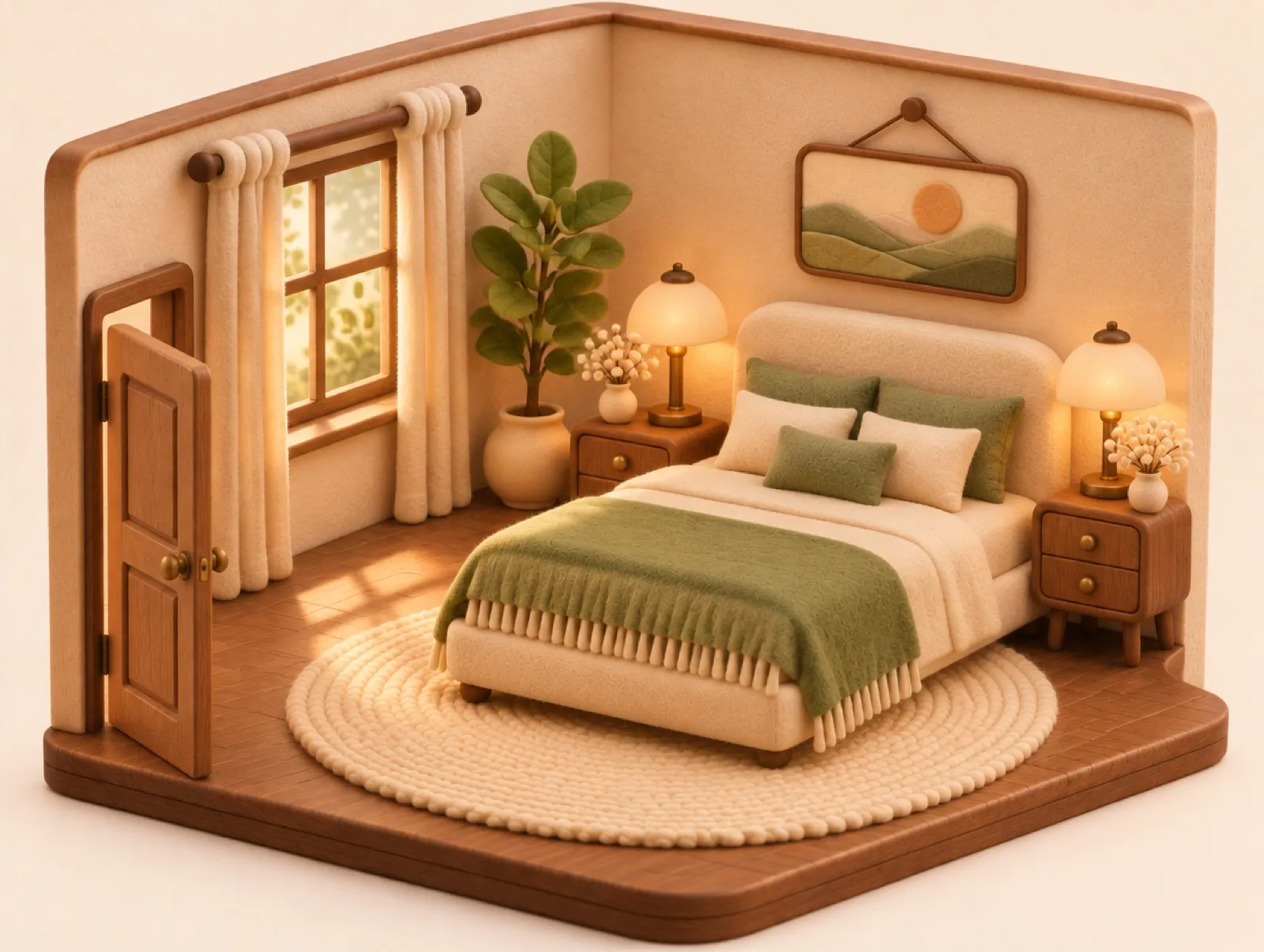
The command position is the single most famous feng shui rule. Your bed, desk and main seat should have a clear view of the door, without sitting directly in line with it.
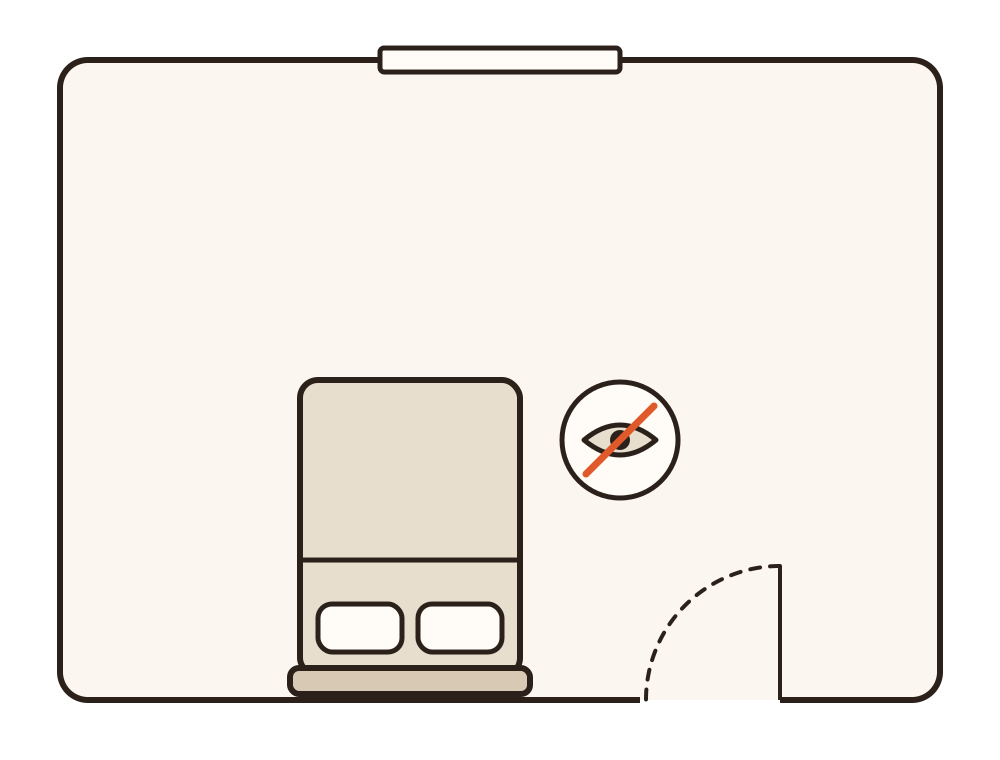
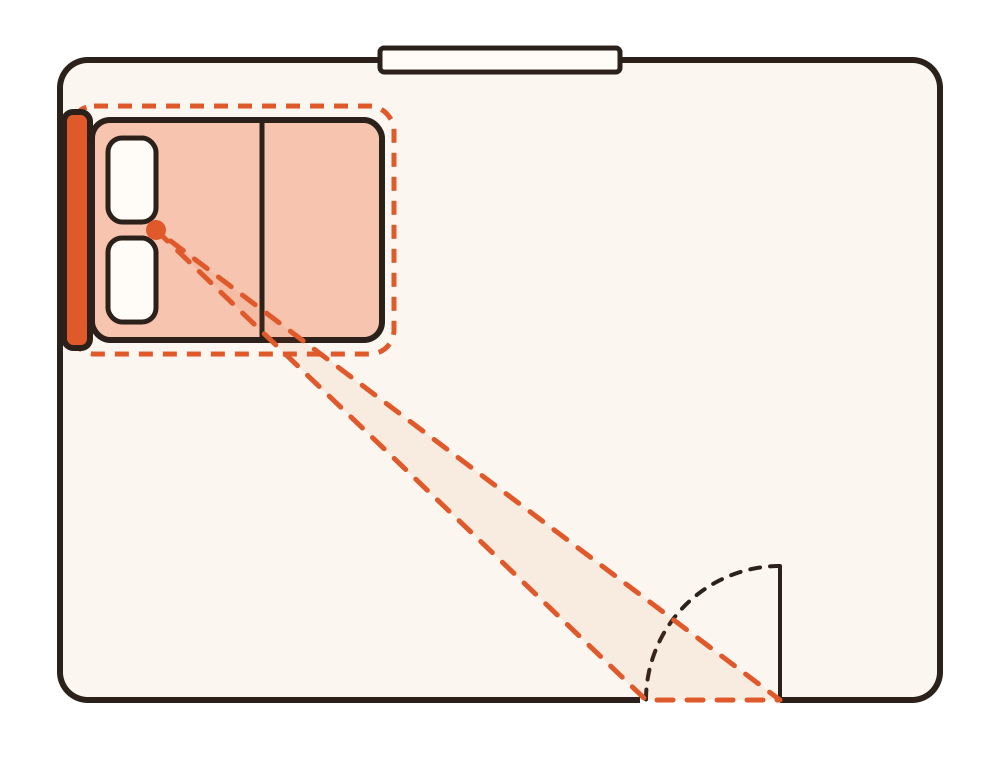
Compare the two plans above. The bed hasn't left the room. It has only moved a few feet and turned, and the room now has a clear sightline from the pillow to the door.
The reason it works is simple. Your brain keeps a low-level watch on the entrance while you rest, and when it can see the door, it can stop watching. That is the whole trick.
Rule 2: Put your back against something solid
A headboard against a solid wall, a sofa with its back to a wall, a desk that doesn't float in the middle of the room. Feng shui calls this "support," and it pairs naturally with rule 1.
Avoid placing a bed directly under a window if you can. A window behind your head means open space where support should be, plus drafts and noise. If it's the only layout the room allows, a heavy headboard and thick curtains do most of the work of a wall.
Rule 3: Let the path meander, not rush
Chi is said to move the way water does: slowly through gentle curves, and too fast through a long straight line. In practical terms, avoid a long clear run from the front door straight through to a back window or balcony door.
75–90 cm (30–36 in) is a comfortable width for main walkways.
Keep your main walkways around that width. Then break any very long sightline with something soft: a plant, a low shelf, a curtain, a rug that turns the eye sideways. It's the same logic as the layering we covered in our post on the rule of three, applied to the whole room instead of one shelf.
Rule 4: Balance the five elements
Feng shui sorts everything in a room into five elements: wood, fire, earth, metal and water. A room that leans too heavily on one tends to feel one-note. Too much metal and glass feels cold, and too much wood and fabric can feel heavy.
- Wood — plants, wooden furniture, tall vertical shapes, greens.
- Fire — warm light, candles, reds and oranges, pointed shapes.
- Earth — ceramics, stone, terracotta, square and low shapes.
- Metal — metal frames, whites and greys, round shapes.
- Water — mirrors, glass, deep blues and black, flowing curves.
You don't need all five in equal measure. Walk through your room and name what's dominant. If everything is grey and glass, add one wood piece and one warm light. If everything is beige fabric, add something with a hard edge.
Rule 5: Clear the entry and the center
Feng shui treats the entrance as the mouth of the room, where everything arrives. If it's blocked by a pile of shoes, a bike or a stack of mail, the whole room starts from a cluttered position. Clear a path you can walk without turning sideways.
Do the same for the middle of the room. It's the heart of the space in the bagua map, and in plain terms it's where people pass through most. Keep it as open as you can.
Rule 6: Use the bagua as a checklist, not a rulebook
The bagua is a 3×3 grid laid over your floor plan, with each of the nine squares linked to an area of life. Align the grid so the bottom edge sits at the room's main entrance.
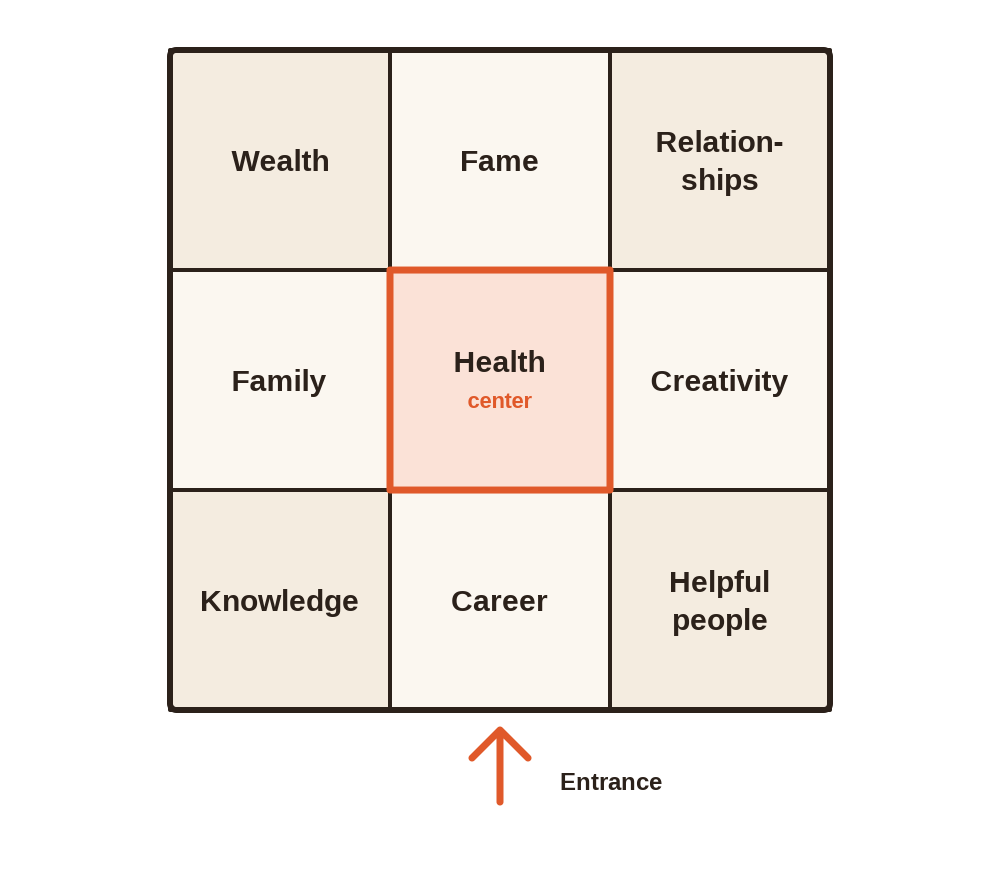
Each square comes with a small suggestion:
- Wealth — plants or something that makes you feel resourced.
- Fame — your best piece of art, or good lighting.
- Relationships — pairs of things: two chairs, two lamps.
- Family — photos and things you love to look at.
- Health (center) — keep this area open and uncluttered.
- Creativity — a corner for projects you enjoy.
- Knowledge — books, a reading chair, a desk.
- Career — a clean, uncluttered entry.
- Helpful people — items from travels, a place to host.
The honest way to use the bagua is as a checklist for neglected corners. If one square is a dumping ground for laundry and cables, give it a small, deliberate upgrade. You don't need to believe it controls your finances to benefit from tidying a corner you've been ignoring.
Try it in 20 minutes
Rearrange one room today:
- Stand in the doorway and note where you'd look first. Clear anything in the way.
- Move your bed or desk so you can see the door without facing it directly.
- Push the headboard or sofa back flush to a solid wall.
- Check your main walkways. Widen any that feel tight.
- Add one element your room is missing: green, warm light or a mirror.
- Sit in the new layout for an evening before you decide to keep it.
If you'd rather test a layout before you lift anything heavy, you can upload a photo of your room to Roomerly and see how a different style and set of pieces would look in your actual space, without buying or moving a thing.
Feng shui isn't a rulebook you have to follow to the letter. It's a set of questions worth asking about any room: what do I see, what supports me, and where does my eye (and my body) want to go? Pair it with the calm lighting and slow evenings from our post on hygge, and the room will start to feel like yours.