Hygge vs. Feng Shui: Two Philosophies of Coziness (and What They Agree On)
Hygge is a Danish mood; feng shui is a Chinese system of layout. One is about what you add to a room, the other about where you put it. They overlap more than you'd expect, and they only clash on lighting and clutter. Here's how to use both without choosing a side.
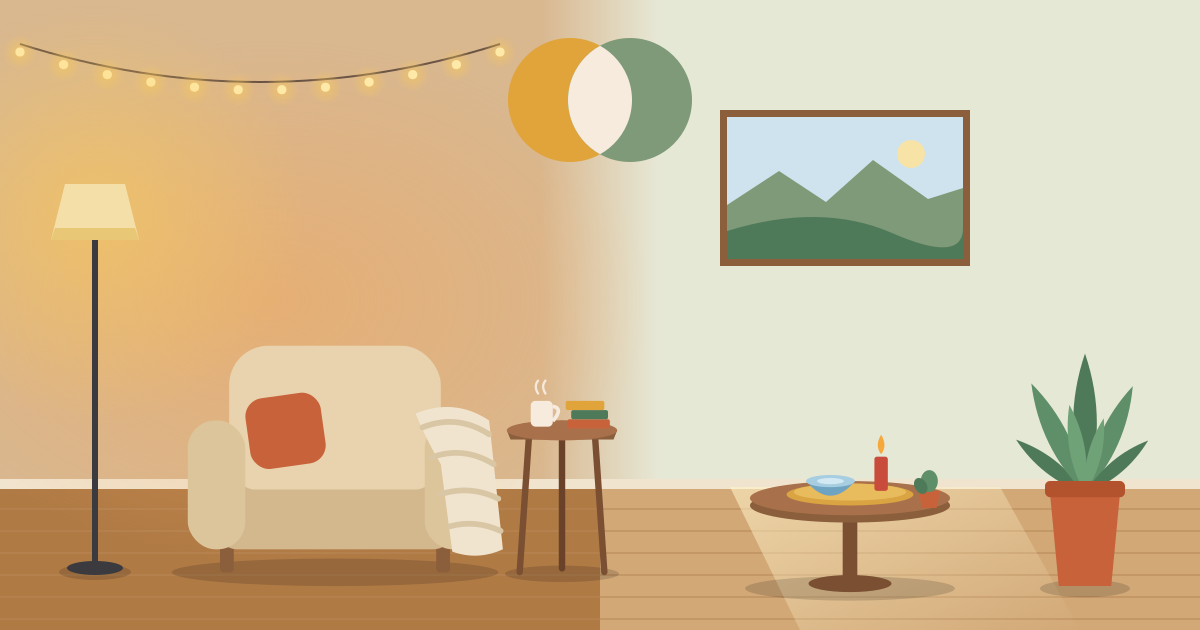
Pinterest says: light a candle. Feng shui says: move your bed.
Both promise a calmer, cozier home. They come from opposite ends of the world, they use opposite vocabulary, and people often treat them as rivals. You don't have to pick one.
Part of the confusion is that each one comes with a cliché. Hygge gets reduced to "buy candles and a blanket", and feng shui to "never put your bed facing the door, because spirits". Both clichés miss what actually works. Let's see what each really does, and where they meet.
Two traditions, one question
Both ask the same question: what makes a room feel good to live in? They answer it from different angles.
Hygge is about what you add. Feng shui is about where you put it.
- Hygge (Denmark): a mood, built from soft light, warm textures, simple rituals and slowing down. It's a feeling you create in the moment, and our hygge guide explains it in detail.
- Feng shui (China): a system of arranging space: where the bed and sofa go, how you move through a room, how the elements are balanced. It's a layout you set once, and our beginner rules cover the practical parts.
So hygge asks "how should this evening feel?", and feng shui asks "is this room set up to support me?"
In practice, hygge shows up as a lamp you switch on at 6 p.m. Feng shui shows up as the sofa you moved a metre to the left and never thought about again. One is a habit, the other is a setup, and that's the main reason they rarely get in each other's way.
The same room, both ways
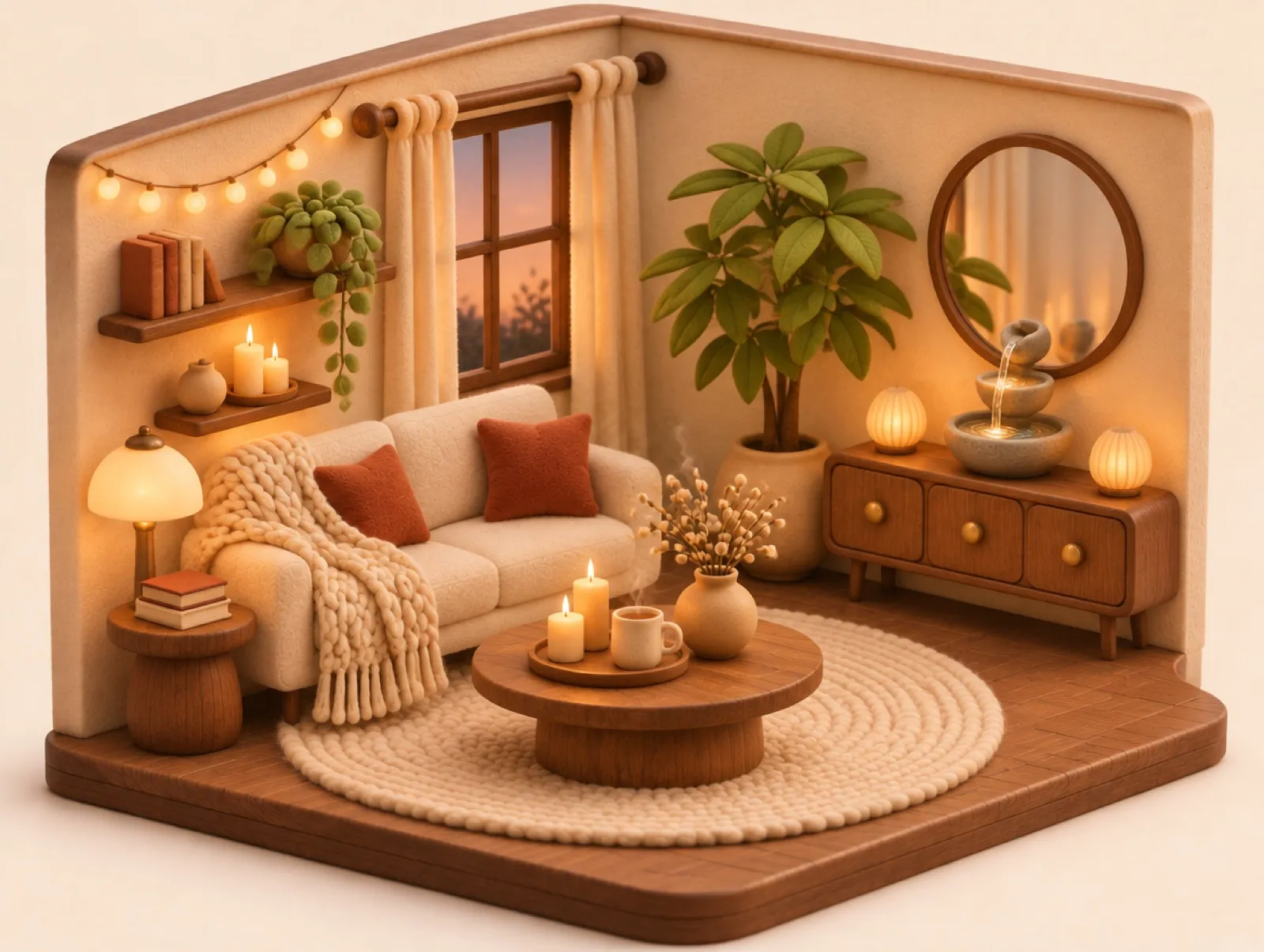
Here's one room styled in each tradition.
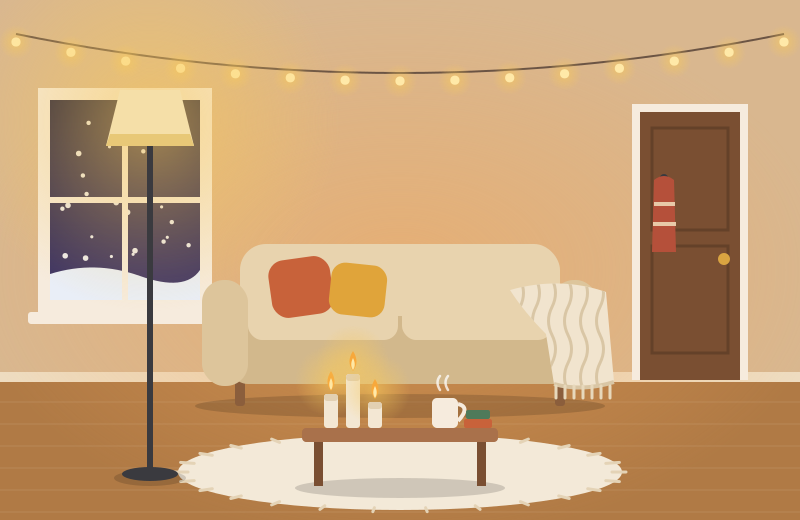
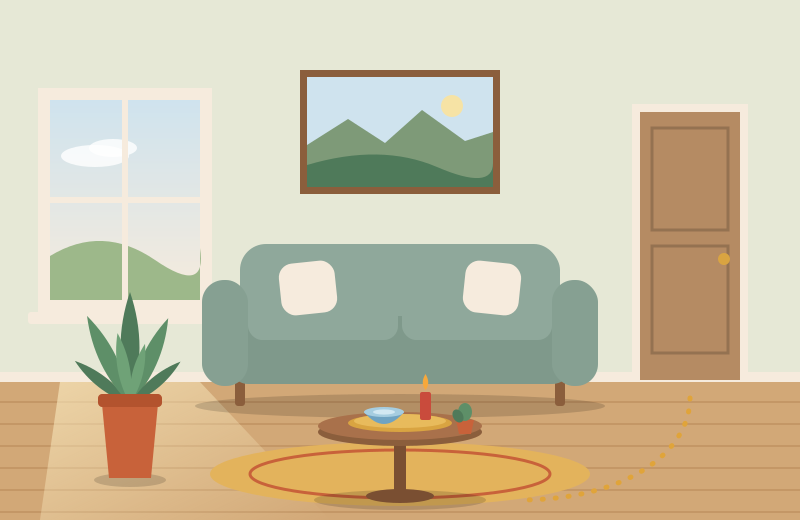
On the left, it's dusk: string lights, snow at the window, a knit throw, candles and a mug on a low table. On the right, it's daytime: the sofa has a solid wall behind it and a clear view of the door, there's a mountain painting for "support", a round table with a little bowl of water, a tall plant, and a clear path from the entrance.
Same sofa, same walls, two very different feelings.
Where they agree
- Only hygge: candlelight and warm glow, blankets and knits, slowing down and small rituals, time with people you love.
- Only feng shui: furniture layout, the command position, the five elements, a clear path from the door.
- Both: natural materials, simplicity over clutter, comfort over show, a feeling of safety, spaces made for rest.
The middle is bigger than most people expect. Both traditions:
- Prefer natural materials: wood, wool, stone, plants.
- Care about intention: fewer things, each one meant.
- Put comfort ahead of looking impressive.
- Want you to feel safe and supported in the room.
- Treat the home as a place to rest, not a showroom.
Where they pull in different directions
They do disagree, mostly on three things.
- Light. Hygge loves low, warm, flickering light. Feng shui prefers bright, natural light and no dark corners.
- Abundance. Hygge welcomes a pile of blankets and a table full of candles. Feng shui wants open floor and clear paths.
- Focus. Hygge is about this evening. Feng shui is about a layout that works every day.
The good news: these conflicts mostly disappear when you separate them by time of day.
Which one does your room need first?
Not sure where to start? Ask how the room feels when it's already tidy.
- It feels awkward. Everything is in place, but you never quite relax. You always take the same seat, and you keep glancing at the door. Start with layout (feng shui).
- It feels cold. The layout works, but the room feels like a showroom or a hotel: hard surfaces, bright light, nothing to sink into. Start with softness (hygge).
If it's both, do the layout first. It's a one-time job, and it makes everything you add afterwards work harder.
A day with both
- Morning: open the curtains, clear the path (feng shui).
- Daytime: bright natural light, a desk where you can see the door (feng shui).
- Evening: overhead off, lamps and candles on (hygge).
- Night: soft textures, phone away, hot drink (hygge).
Feng shui sets up the stage. Hygge decides how the evening feels on it.
How to use both in one room
Four moves, in this order:
- 1. Arrange first. Put your bed or sofa against a solid wall with a view of the door, and keep a 75–90 cm (30–36 in) path.
- 2. Soften second. Add one layer per sense: a warm lamp, a knit throw, a candle, a hot drink.
- 3. Edit weekly. Remove three things you haven't touched. Both traditions agree on this.
- 4. Switch modes by time. Bright and clear by day, dim and warm by evening.
Everything in these four moves can be undone: furniture moves, lamps plug in, throws fold. That's why it suits a rental as much as a home you own, and our weekend cozy corner guide shows a small version of it.
The order matters. A beautiful candlelit corner in a room where you can't relax (your back to the door, a path you trip over) only works for an hour. A well-arranged room with nothing soft in it is correct and a bit cold. You need both layers.
And no, you don't have to believe in chi, or in any of this. Treat both as a set of tested habits for a home that feels good.
Three mistakes when mixing them
- Treating either one as a shopping list: a bulk "hygge kit" of candles, or a bagua map you try to fill with objects.
- Dimming every light and calling it hygge in a room you can't cross without bumping into things.
- Rearranging furniture every week to chase "better energy". Layout is a one-time setup, so change it only when something doesn't work.
Where Roomerly fits
Feng shui is about layout, and that part is yours: it needs you, a tape measure and an evening. The soft layer is where it gets easier. If you've set your layout and want to see which lamps, throws and plants would suit your room, you can upload a photo to Roomerly. It suggests a style and a palette, then lists real pieces within your budget. It won't move your sofa, but it can help you choose what goes next to it.
Hygge and feng shui aren't rivals. One gives you the stage, the other gives you the mood.